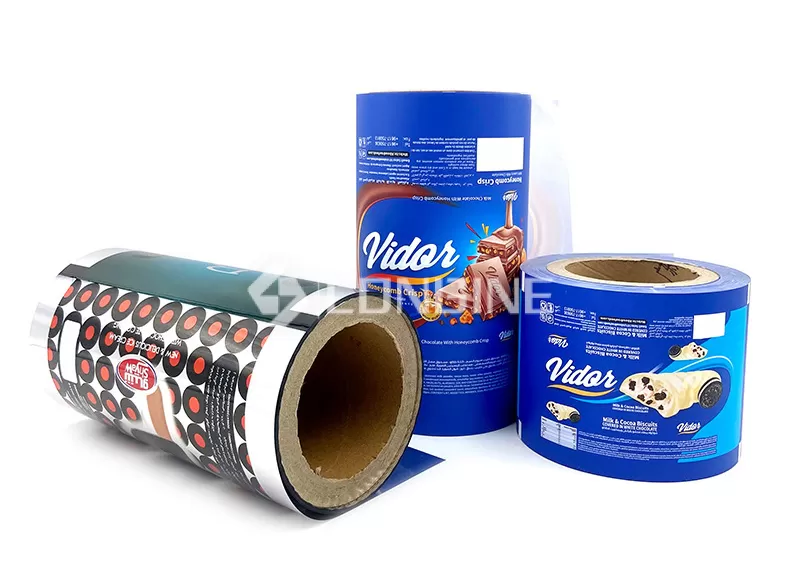
Snack packaging needs to do more than make a product look attractive on the shelf. The packaging film must help protect the snack from moisture, oxygen, light, odors, and physical damage while also providing reliable sealing and smooth performance on automatic packaging machines.
For products such as potato chips, nuts, popcorn, crackers, cookies, candy, and dried fruit, choosing the right plastic roll film can directly affect product freshness, texture, shelf life, and packaging efficiency.
So, what should you look for when choosing plastic roll film for snacks packaging?
The answer depends on the type of snack, its oil and moisture content, required shelf life, packaging machine, storage conditions, and desired appearance. Common materials include BOPP, PET, PE, CPP, PA, and high-barrier structures using metallized films or other barrier layers.
Why Is Plastic Roll Film Important for Snack Packaging?
Many snacks are particularly sensitive to moisture and oxygen.
For example, potato chips, crackers, popcorn, and other crispy products can lose their texture when moisture enters the package. Nuts and other high-fat snacks may require stronger oxygen protection because oxidation can affect flavor and quality.
Snack packaging film therefore needs to provide a combination of:
Moisture protection
Oxygen protection
Light protection when required
Aroma retention
Good heat sealing
Puncture and tear resistance
Reliable machine performance
Attractive printing and appearance
A single plastic material does not necessarily provide all of these properties. This is why multilayer laminated roll film is commonly used for demanding snack packaging applications.
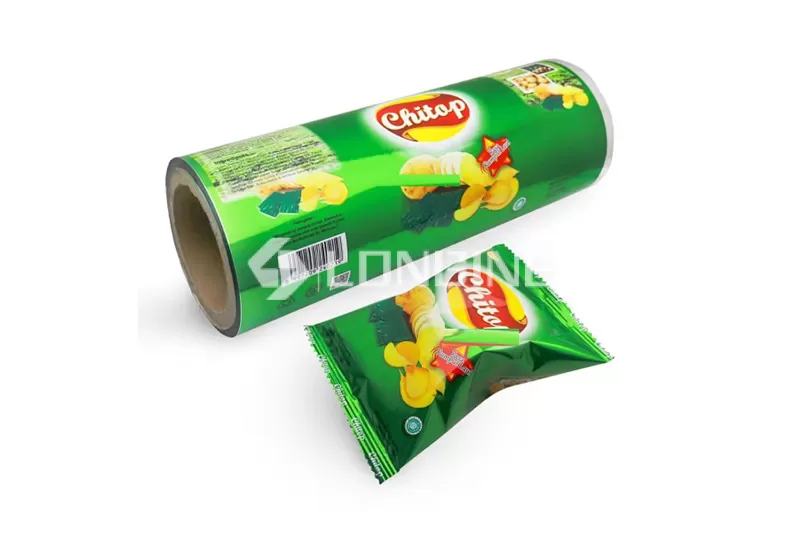
What Features Should Snack Packaging Roll Film Have?
The right plastic roll film should be selected according to the actual requirements of the snack product.
Moisture Barrier
Moisture is one of the most important concerns for crispy snacks.
Potato chips, crackers, popcorn, cereal snacks, and similar products can become soft or lose their desired texture when exposed to excessive moisture.
A suitable film structure should therefore provide sufficient moisture barrier performance for the product's target shelf life and storage conditions.
BOPP is commonly used in snack packaging partly because it offers useful moisture resistance. For products requiring stronger protection, metallized or multilayer structures can be considered.
Oxygen Barrier
Oxygen can be particularly important for snacks containing oils and fats, such as nuts, potato chips, seeds, and fried snacks.
Exposure to oxygen can contribute to oxidation and flavor deterioration.
Depending on the product, oxygen-sensitive snacks may require a higher-barrier structure incorporating materials such as metallized film, EVOH, or aluminum foil.
The required barrier level should be determined by the product formulation, shelf life, packaging process, and storage environment.
Light Protection
Some snacks are sensitive to light, particularly products containing oils or ingredients that can be affected by oxidation.
A transparent film may be sufficient for some products, while others may benefit from a metallized or opaque structure.
Metallized films can also provide a distinctive metallic appearance that is often used for premium snack packaging.
Aroma Protection
Many snacks depend on their characteristic aroma and flavor.
Seasoned chips, spicy snacks, roasted nuts, coffee-flavored snacks, and other strongly flavored products may require packaging with appropriate aroma barrier properties.
A properly designed multilayer structure can help reduce the movement of gases and volatile compounds through the packaging.
Strong and Reliable Sealing
A snack package is only effective if it remains properly sealed.
The inner sealing layer is responsible for creating the package closure and maintaining package integrity.
Common sealing materials include:
PE
CPP
Heat-sealable BOPP
Other specially engineered sealant films
The sealing layer should be compatible with the packaging machine, sealing temperature, machine speed, and product characteristics.
Which Materials Are Commonly Used for Snack Packaging Roll Film?
Several plastic films are commonly used for snack packaging.
BOPP Film
BOPP stands for biaxially oriented polypropylene.
It is widely used in flexible snack packaging because it can provide:
Good clarity
Good stiffness
Good printability
Useful moisture barrier
Attractive surface appearance
Good performance on many automatic packaging lines
BOPP is frequently used as an outer or printable layer in laminated structures.
Standard BOPP should not automatically be treated as the sealing layer. Depending on the specific grade, it may need to be combined with PE, CPP, or another heat-sealable layer.
PET Film
PET is another common material for flexible snack packaging.
It provides good:
Mechanical strength
Dimensional stability
Printability
Surface appearance
Heat resistance
PET is often used as the outer layer of laminated snack packaging.
For example, PET/PE can be suitable for various snack applications where strength, printing, and heat sealing need to be balanced.
PE Film
Polyethylene is commonly used as a sealing layer and flexible packaging material.
PE offers:
Good flexibility
Good toughness
Moisture resistance
Heat-sealing performance
Good puncture resistance
PE is particularly useful when the package needs a reliable inner seal.
It can also be used in recyclable mono-material packaging structures when the application and required performance allow.
CPP Film
Cast polypropylene, or CPP, can provide good heat-sealing performance and is commonly used as an inner layer in flexible packaging.
BOPP/CPP is one example of a structure that can be considered for certain snack applications where clarity, stiffness, sealing, and moisture protection need to be balanced.
Metallized Film
Metallized films are used when stronger barrier performance is required.
A thin metallic layer can improve protection against oxygen, moisture, and light compared with standard transparent film structures.
Metallized BOPP, metallized PET, and metallized CPP can be incorporated into different laminated structures depending on the application.
These structures are often considered for products such as:
Potato chips
Fried snacks
Nuts
Seeds
Dried fruit
High-fat snacks
Aluminum Foil
Aluminum foil provides very strong barrier protection against oxygen, moisture, and light.
However, it is generally selected when the product requires a higher level of protection because it can increase material cost and affect the appearance and flexibility of the final package.
For many standard snack applications, metallized film can provide a practical balance between barrier performance and cost.
Which Plastic Roll Film Is Best for Different Snacks?
There is no single best structure for every snack.
The following examples can help explain how material selection works.
| Snack Product | Common Film Options | Main Requirements |
|---|---|---|
| Potato Chips | BOPP/CPP, BOPP/VMPET/PE | Moisture, oxygen, light and sealing |
| Popcorn | BOPP/CPP, high-barrier laminates | Moisture and mechanical protection |
| Nuts | PET/VMPET/PE, PET/AL/PE | Oxygen, moisture and light protection |
| Dried Fruit | PET/PE, PET/VMPET/PE | Moisture and oxygen protection |
| Crackers | BOPP/CPP, PET/PE | Moisture barrier and sealing |
| Cookies | BOPP/CPP, PET/PE | Moisture, appearance and machinability |
| Candy | BOPP/CPP and other suitable films | Clarity, printing and sealing |
| Chocolate Snacks | Metallized or specialized structures | Light, aroma and temperature considerations |
| Granola | PET/PE, BOPP/PE, high-barrier laminates | Moisture and oxygen protection |
| Roasted Seeds | PET/VMPET/PE | Oxygen, moisture and aroma protection |
These structures are starting points rather than universal specifications. The final film should be selected based on the actual product, target shelf life, packaging format, machine, and storage conditions.
What Is the Best Film for Potato Chip Packaging?
Potato chips are a good example of why snack packaging requires multiple performance characteristics.
They need protection against moisture because moisture can quickly affect crispness. They may also require oxygen and light protection because the oil content can make oxidation an important consideration.
A high-barrier structure such as BOPP/VMPET/PE can combine several useful functions:
BOPP provides an attractive printable outer layer
VMPET provides enhanced barrier and light protection
PE provides heat sealing and package integrity
For applications with different performance requirements, other structures such as BOPP/CPP or PET-based laminates may also be appropriate.
The correct structure should be determined through product and machine testing rather than selected solely because it is commonly used.
What Is the Best Film for Nut Packaging?
Nuts contain oils and are therefore often more sensitive to oxygen exposure than many low-fat dry snacks.
Packaging film for almonds, peanuts, cashews, pistachios, mixed nuts, and similar products may require:
Strong oxygen barrier
Moisture protection
Aroma retention
Light protection
Puncture resistance
Reliable sealing
PET/VMPET/PE and PET/AL/PE are examples of structures that can be considered when stronger barrier performance is required.
For premium nut products with long distribution routes or extended shelf-life requirements, the packaging structure may need to provide a higher level of protection.
How Does Film Selection Affect Snack Shelf Life?
Packaging film is only one part of shelf-life performance, but it can play an important role.
Shelf life can be affected by:
Oxygen transmission
Water vapor transmission
Package seal integrity
Product moisture content
Product fat content
Storage temperature
Light exposure
Packaging atmosphere
Package size and headspace
For example, a snack may have excellent barrier film but still experience quality problems if the seal is weak or the packaging process introduces excessive oxygen.
This is why film selection should be considered together with the entire packaging process.
What About Nitrogen-Flushed Snack Packaging?
Many snack products are packed using modified atmospheres, including nitrogen flushing.
Nitrogen can help create a protective package environment and may also help reduce mechanical damage to fragile snacks during transportation.
When nitrogen flushing is used, the packaging film and seals need to maintain the required package integrity.
Important considerations include:
Film barrier performance
Seal strength
Leak resistance
Sealing conditions
Package design
Gas flushing process
A high-barrier film alone cannot compensate for poor seals or an unsuitable packaging process.
How Does Plastic Roll Film Work on Automatic Snack Packaging Machines?
Plastic roll film is widely used with automatic packaging equipment because the continuous roll allows the machine to form, fill, and seal packages during production.
Common equipment includes:
VFFS machines
HFFS machines
Flow wrapping machines
Sachet machines
Stick-pack machines
For snack packaging, the film may need to meet precise requirements for:
Film width
Thickness
Roll diameter
Core size
Printing repeat
Eye mark position
Coefficient of friction
Sealing temperature
Machine speed
A film structure that is suitable for one machine may require adjustment for another.
Therefore, machine specifications should always be considered before mass production.
What Is the Difference Between Clear and Metallized Snack Film?
Both clear and metallized films can be useful, but they serve different packaging objectives.
| Feature | Clear Film | Metallized Film |
|---|---|---|
| Product visibility | Excellent | Limited |
| Moisture protection | Good depending on structure | Generally higher |
| Oxygen protection | Depends on structure | Generally higher |
| Light protection | Limited | Strong |
| Appearance | Transparent | Metallic |
| Suitable for | Many standard snacks | High-barrier applications |
Clear packaging can be useful when consumers need to see the product.
Metallized packaging is more suitable when stronger light and barrier protection is required.
The decision should therefore be based on both product protection and marketing requirements.
Should You Choose Recyclable Plastic Roll Film for Snacks?
Recyclable packaging is becoming increasingly important for food and snack brands.
For suitable applications, mono-material PE or PP structures can be considered as alternatives to conventional multilayer structures.
However, changing to a recyclable film should not be based only on the word "recyclable."
The new structure still needs to meet the packaging requirements for:
Moisture barrier
Oxygen barrier
Sealing
Puncture resistance
Machine performance
Printing
Shelf life
For some snacks, a mono-material structure may be suitable. For others, additional barrier technology may be required.
The best approach is to evaluate sustainability together with actual product protection and production requirements.
How to Choose the Right Snack Packaging Roll Film
Before selecting a plastic roll film supplier, answer the following questions.
1. What Type of Snack Are You Packaging?
Identify whether the product is:
Fried
Oily
Dry
Moisture-sensitive
Powdered
Crunchy
Frozen
Aroma-sensitive
2. What Shelf Life Do You Need?
A snack intended for short local distribution may require a different film structure from one shipped internationally and stored for many months.
3. Does the Product Need Light Protection?
If the product contains oils or is sensitive to light, consider whether a metallized or opaque structure is necessary.
4. What Packaging Machine Are You Using?
Tell your supplier whether you are using VFFS, HFFS, flow wrapping, or another packaging system.
5. What Type of Seal Do You Need?
Determine whether the package requires:
Heat sealing
Cold sealing
High-speed sealing
Strong hot tack
Wide sealing range
6. Do You Need Custom Printing?
For retail snacks, packaging design is often an important part of the product presentation.
The film can be customized with:
Brand graphics
Product information
Nutrition information
Barcode
Multiple colors
Matte or glossy finishes
Special visual effects
What Should You Test Before Ordering Snack Packaging Film?
Before placing a large order, it is recommended to test the film under actual packaging conditions.
Important tests include:
Film Appearance
Check:
Transparency
Gloss
Printing quality
Surface defects
Color consistency
Mechanical Performance
Check:
Tensile strength
Tear resistance
Puncture resistance
Flexibility
Sealing Performance
Evaluate:
Seal strength
Seal temperature
Hot tack
Seal consistency
Leakage resistance
Machine Performance
Run the film through your actual packaging equipment and check:
Film feeding
Tension
Tracking
Eye mark detection
Forming
Sealing
Cutting
Machine speed
Testing the finished package is the most reliable way to determine whether the selected roll film is suitable for your snack product.
How Can Longine Packing Help With Snack Packaging Film?
Longine Packing provides custom plastic roll film and flexible packaging solutions for food and snack applications.
Based on the product and packaging requirements, the film structure can be developed around factors such as:
Snack type
Product weight
Oil content
Moisture sensitivity
Target shelf life
Packaging machine
Film dimensions
Barrier requirements
Printing requirements
Sealing method
Whether you need packaging film for potato chips, nuts, popcorn, cookies, crackers, candy, dried fruit, granola, or other snacks, selecting the right material structure is essential for achieving reliable packaging performance.
Longine Packing can work with customers to develop suitable roll film specifications for their packaging applications, including customized material structures, sizes, printing, and performance requirements.
Conclusion
Choosing plastic roll film for snacks packaging requires more than selecting a material based on price.
The film needs to protect the snack from the main factors that can affect quality, including moisture, oxygen, light, aroma loss, and physical damage. At the same time, it must provide reliable sealing and stable performance on the packaging machine.
BOPP is widely used for its clarity, stiffness, printability, and moisture resistance. PET provides strong mechanical and printing performance, while PE and CPP are commonly used as sealing layers. When higher barrier protection is needed, metallized films, EVOH, or aluminum foil can be incorporated into the packaging structure.
The right choice ultimately depends on the snack product, target shelf life, packaging equipment, storage conditions, and required barrier performance.
If you are looking for custom plastic roll film for snacks packaging, contact Longine Packing with your product information, packaging machine specifications, film size, printing requirements, and expected order quantity. We can help you evaluate a suitable flexible packaging structure for your application.