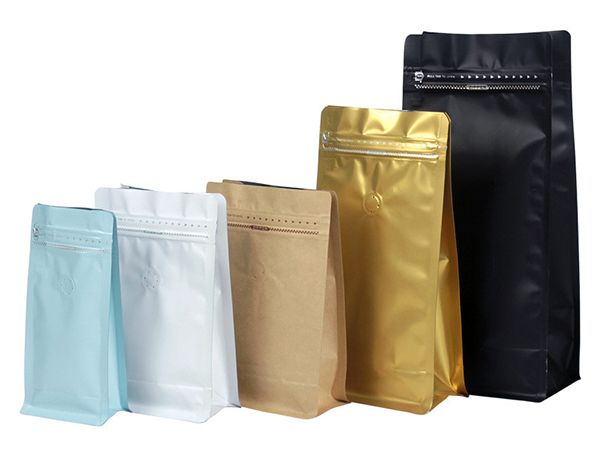
Roasting coffee is a delicate art that requires precise temperature profiling, timing, and an intimate understanding of agricultural chemistry. However, the moment those perfectly roasted beans drop from the cooling tray, the clock starts ticking. Without the right protection, even a 90-point Geisha will lose its complex aromatics and vibrant acidity within a matter of days.
Many new roasters make the critical mistake of treating bags for coffee as simple carrying vessels. In reality, a high-quality coffee bag is a highly engineered, multi-layered micro-environment designed to perform a very specific scientific task: letting gases out while keeping the elements at bay.
As we navigate through 2026, the specialty coffee industry is demanding packaging that not only preserves peak freshness but also aligns with stringent aesthetic and environmental standards. Whether you are a micro-roaster launching your first retail line or a wholesale supplier upgrading your bulk packaging, this complete guide will break down the material science, structural designs, and essential features you need to choose the perfect bags for coffee.
1. The Science of Coffee Freshness: Why Packaging Matters
To understand why coffee requires specialized packaging, we must first look at the volatile chemistry of the roasted bean. Standard food packaging, like a basic polybag or a mason jar, is fundamentally incapable of protecting fresh coffee.
The Four Enemies of Roasted Coffee
From the moment roasting finishes, coffee beans are under constant attack by four environmental elements:
Oxygen: The absolute worst offender. When oxygen interacts with the delicate lipids and essential oils on the surface of the coffee bean, it causes rapid oxidation. This strips the coffee of its nuanced flavor notes and introduces a flat, cardboard-like rancidity (staling).
Light (UV): Ultraviolet rays act as a catalyst for oxidation. Prolonged exposure to direct sunlight or harsh retail fluorescent lighting breaks down the chemical structures of the beans, destroying their aroma.
Moisture: Roasted coffee is incredibly hygroscopic, meaning it acts like a sponge for ambient humidity. If beans absorb moisture, the oils degrade faster, and in severe cases, the coffee can develop mold.
Heat: Elevated temperatures accelerate all of the chemical degradation processes mentioned above.
The Post-Roast Degassing Process
During the roasting process, complex carbohydrates inside the coffee bean break down, creating massive amounts of carbon dioxide ($CO_2$). A significant portion of this gas is trapped inside the porous cellular structure of the bean. Over the next 7 to 14 days, the beans will naturally release this trapped gas into the atmosphere—a process known as "degassing." A dark roast will degas violently and rapidly, while a light roast will release $CO_2$ slowly over a longer period.
2. The Non-Negotiable Feature: One-Way Degassing Valves Explained
Because freshly roasted coffee continuously emits carbon dioxide, packaging it presents a unique physics problem. This is where the one-way degassing valve—the defining feature of professional bags for coffee—becomes absolutely non-negotiable.
How a Degassing Valve Works (Mechanics)
A degassing valve is a small, precision-engineered plastic button (usually heat-welded into the inner layer of the bag) that contains a flexible rubber diaphragm and a specialized fluid sealant.
When the coffee beans release $CO_2$, pressure builds up inside the sealed bag. Once the internal pressure slightly exceeds the external atmospheric pressure, it pushes the rubber diaphragm open, venting the $CO_2$ safely outside. However, because it is a "one-way" mechanism, the external atmospheric pressure immediately pushes the diaphragm shut the moment the internal pressure normalizes. This brilliant mechanical design guarantees that oxygen can never enter the bag.
What Happens if Bags for Coffee Don't Have Valves?
If you package fresh, off-gassing coffee in a completely airtight bag without a valve, the bag will quickly inflate like a balloon and eventually burst at the seams under the pressure.
Conversely, if you try to solve the pressure problem by simply poking a pinhole in the bag, you relieve the $CO_2$ pressure, but you also invite a continuous stream of oxygen inside. Without a one-way valve, your carefully roasted coffee will go completely stale in less than a week.
3. Popular Styles and Form Factors for Coffee Bags
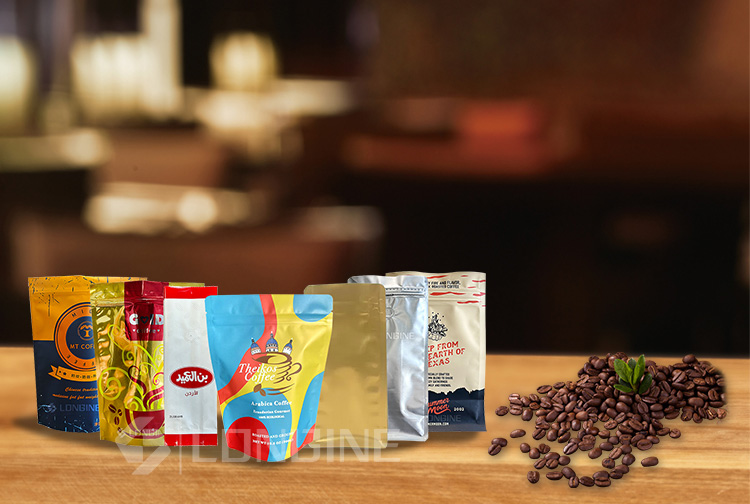
Once the science of preservation is handled, the next critical decision is the physical shape of the bag. The form factor dictates how the product displays on retail shelves, how easy it is to fill, and how the consumer interacts with it at home.
Stand-Up Pouches (Doypacks)
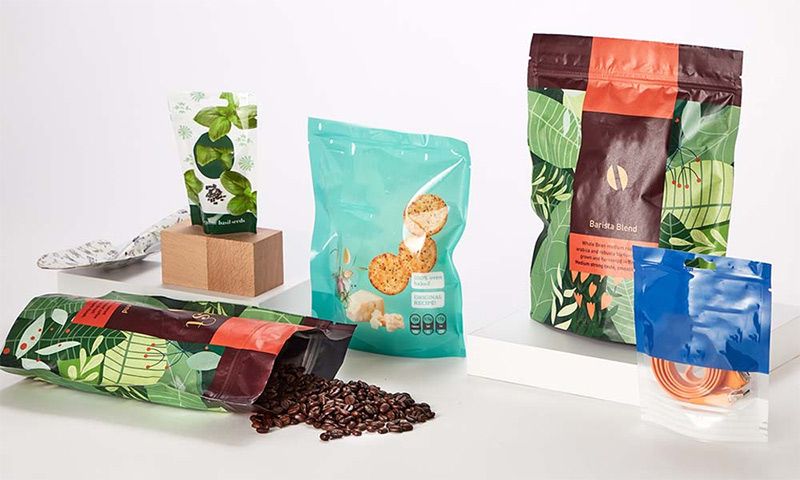
The Stand-Up Pouch features a rounded bottom gusset that allows the bag to stand vertically once filled.
Best for: Standard 250g (8oz) or 340g (12oz) retail sizes.
Pros: They are cost-effective, easy to fill using semi-automated equipment, and usually feature a resealable zipper at the top. This is the undisputed workhorse of the modern retail coffee industry.
Flat Bottom Bags (Box Pouches)
Also known as block-bottom or eight-side-seal bags, this is the premium standard for specialty coffee in 2026. The bag is constructed with a completely flat, rectangular base and four distinct side panels.
Best for: High-end specialty roasters who want maximum shelf presence.
Pros: It mimics the structural rigidity of a box, meaning it never tips over on a crowded supermarket shelf. It also provides five distinct printable surfaces (front, back, left, right, and bottom), giving roasters massive real estate for branding and origin storytelling.
Side Gusset Bags
The Side Gusset Bag is a traditional, tubular style with folded sides and a flat back and front. It does not have a flat bottom, meaning it relies on the weight of the coffee to stand upright.
Best for: Wholesale bulk distribution (1kg / 2lb to 5lb sizes) for cafes and restaurants.
Pros: They are incredibly space-efficient for shipping and highly economical. They do not typically come with zippers; instead, they are folded down and sealed with an adhesive tin tie after opening.
Quad Seal Pouches
A hybrid between a side gusset and a flat bottom. All four vertical corners of the bag are heat-sealed, giving the bag a very crisp, rigid, and professional shape.
Best for: Supermarket retail where bags might be handled frequently by consumers. The reinforced corners prevent the bag from looking crumpled or sloppy.
4. Material Selection: Balancing Barrier Properties and Aesthetics
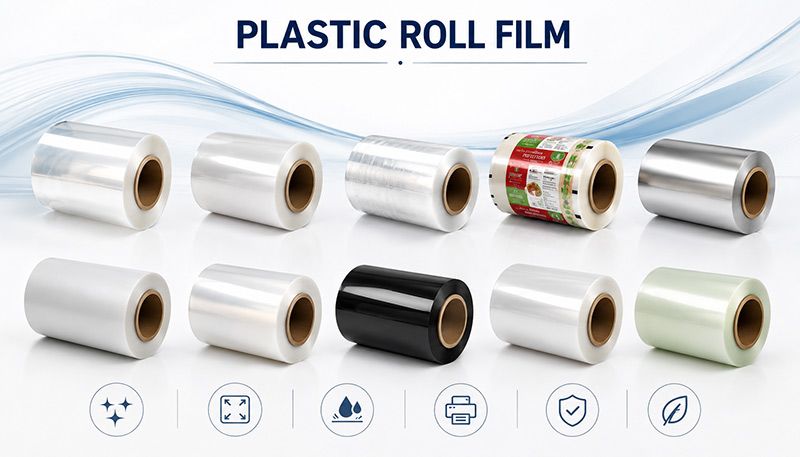
A coffee bag is only as good as the barrier films used to construct it. Most high-quality bags for coffee are laminated structures, meaning they fuse an aesthetic outer layer with highly functional inner barrier layers.
Aluminum Foil Laminates (AL)
A traditional 3-ply foil structure looks like this: PET (Outer Print Layer) / AL (Aluminum Barrier) / LLDPE (Inner Sealant).
Pure aluminum foil is the ultimate gold standard for coffee preservation. It provides a 100%, absolute zero-transmission barrier against oxygen, moisture, and UV light. If you are shipping coffee internationally or require a shelf life of 12 to 18 months, an aluminum foil laminate is the only safe choice.
Metalized Polyester (VMPET)
Instead of a solid sheet of foil, VMPET is a layer of PET plastic that has had a microscopic mist of aluminum vaporized onto it.
It provides excellent barrier properties (though not quite as absolute as pure AL) but is significantly lighter, more flexible, and generally more cost-effective. It is the most common barrier layer used for standard 3-to-6-month retail coffee distribution.
Kraft Paper Outer Layers: The Natural Myth
Many artisanal roasters love the rustic, organic look of a brown kraft paper bag. However, there is a dangerous misconception that these bags are made only of paper. Raw paper is highly porous; oxygen and moisture will pass right through it, and the coffee oils will quickly soak into the paper, leaving ugly grease stains.
High-quality "kraft bags for coffee" are actually laminated structures: Kraft Paper (Outer) / VMPET (Middle Barrier) / LLDPE (Inner Sealant). The paper simply provides the textured, artisanal aesthetic, while the hidden high-tech polymers and metals do the actual work of preserving the coffee.
5. The 2026 Shift: Sustainable Bags for Coffee
For years, the coffee industry faced a harsh reality: the multi-layered foil bags that perfectly preserved the coffee were completely unrecyclable. Because traditional bags fuse different materials together (like PET plastic, Aluminum, and PE), recycling facilities cannot separate them, meaning millions of bags for coffee end up in landfills.
By 2026, consumer demand for sustainability has forced a massive technological shift. However, roasters must navigate this carefully to avoid "greenwashing" and ensure their beans are still protected.
Recyclable Mono-Materials (PE/PE Structures)
The absolute gold standard for sustainable bags for coffee in 2026 is the mono-material structure. Instead of mixing different plastics and metals, these bags are made entirely from a single polymer family—usually 100% Polyethylene (PE/PE) or Polypropylene (PP/PP).
To replace the oxygen-blocking aluminum foil layer, manufacturers now use an ultra-thin, recyclable EVOH (Ethylene Vinyl Alcohol) high-barrier coating. Because the entire bag is made of the same base plastic, it is fully eligible for "Store Drop-Off" soft plastic recycling programs, creating a true circular economy without sacrificing shelf life.
Biodegradable and Compostable Options (PLA)
Compostable bags are typically made from PLA (Polylactic Acid), a bioplastic derived from renewable resources like corn starch or sugarcane.
While they sound perfect, they come with a caveat: they require industrial composting facilities (which use sustained high heat and moisture) to break down. They will not decompose in a backyard garden compost bin. Additionally, early-generation compostable bags had very poor oxygen and moisture barriers, meaning coffee staled within weeks. Today, advanced compostable high-barrier films are available, but they remain significantly more expensive than mono-materials.
The Challenge of Sustainable Valves and Zippers
A major pitfall for roasters is buying a 100% compostable paper/PLA bag, only to realize the manufacturer installed a standard, non-biodegradable polyethylene degassing valve and zipper. If even one component of the bag is traditional plastic, the entire package contaminates the compost or recycling stream. When sourcing sustainable bags for coffee, you must explicitly verify that the valve, zipper, and laminating adhesives are fully certified compostable or recyclable alongside the main bag material.
6. Functional Features to Enhance Consumer Experience
Once the coffee reaches the consumer's kitchen, the bag transitions from a protective shipping vessel to a daily-use container. The functional features you choose directly impact brand loyalty.
Resealable Zippers (Pocket Zippers vs. Standard)
Once a customer cuts open the heat seal, the coffee is exposed to oxygen. A high-quality resealable zipper is essential for maintaining freshness at home.
Standard Press-to-Close (PTC) Zippers: Common on stand-up pouches, these are simple and cost-effective.
Pocket Zippers (Rip-Pull Zippers): Highly popular on premium flat-bottom bags. The zipper is hidden behind a tear-away strip on the front of the bag. This allows roasters to easily fill the bag from the wide-open top without the zipper getting in the way of the filling machinery, streamlining the production line.
Tin Ties for Side Gusset Bags
Side gusset bags (which lack the structural capability to hold a standard zipper) rely on tin ties—a flexible plastic strip with a metal wire core attached to the top of the bag. Consumers simply roll the top of the bag down tightly and fold the metal tabs over to hold it in place. While cost-effective and traditionally aesthetic, tin ties do not provide an airtight seal; they are best suited for wholesale cafe accounts that will consume the 1kg bag within a few days.
Tear Notches and Laser Scoring
Nothing frustrates a consumer more than needing scissors to open a bag of coffee, or worse, tearing it by hand and ripping down the side of the bag, destroying the zipper.
Tear Notches: Small pre-cut slits on the sides of the bag above the zipper.
Laser Scoring: A premium 2026 feature. A laser creates a microscopic, perfectly straight weakened line across the top of the pouch. When the consumer pulls the tear notch, the bag opens with a satisfying, perfectly horizontal tear, keeping your branding looking pristine.
7. Sizing Guide: Matching the Bag to Your Roast Volume
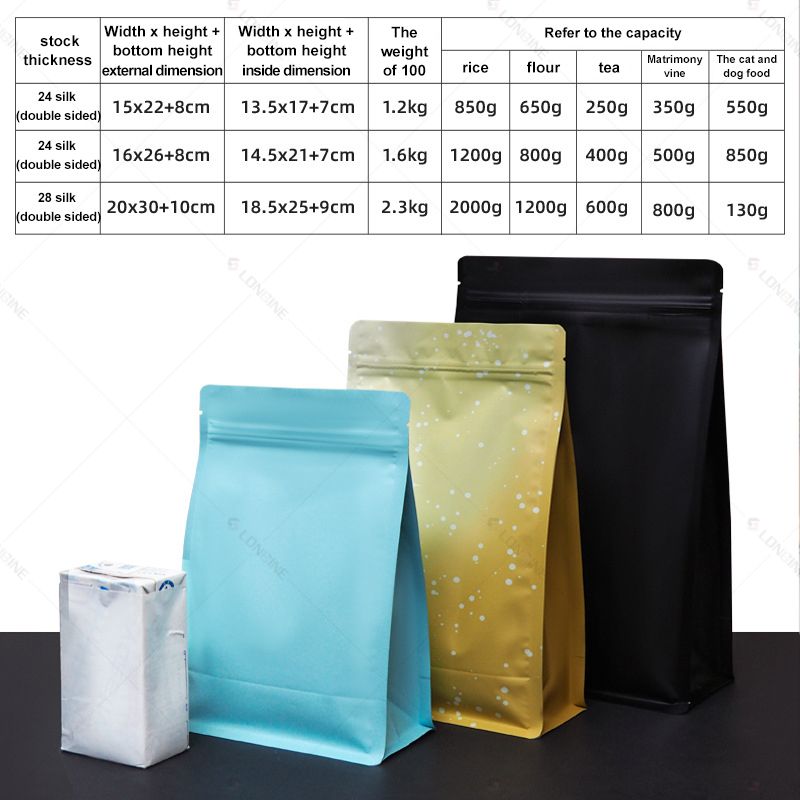
One of the most expensive mistakes a new roaster can make is ordering 10,000 custom-printed bags, only to discover their coffee doesn't fit inside. Why does this happen? Because weight does not equal volume in the coffee world.
Understanding Bean Density (Dark vs. Light Roast)
During the roasting process, raw green coffee beans lose moisture (weight) and physically expand (volume).
Light Roasts (e.g., Cinnamon or Nordic style): These beans are roasted for a shorter time. They retain more of their original density, moisture, and weight. They are physically smaller and heavier.
Dark Roasts (e.g., French or Italian roast): These beans are pushed to a "second crack." They lose up to 20% of their water weight and puff up significantly. They are highly porous, physically large, and very light.
The Result: 250 grams of a dense Light Roast will easily fit into a standard 8oz coffee bag with plenty of room to spare. However, 250 grams of a puffy Dark Roast takes up drastically more physical volume. If you use a dark roast profile, it will overflow the exact same bag, making it impossible to heat-seal the top.
The Golden Rule: Before finalizing the dimensions of your bags for coffee, always physically test your darkest roast profile in a sample bag to ensure you have enough headspace for filling and sealing.
8. FAQs
Q: How long do coffee beans stay fresh in a sealed bag?
A: If packaged in a high-barrier foil bag equipped with a one-way degassing valve and stored in a cool, dark place, whole bean coffee can remain commercially fresh for 6 to 12 months. However, for peak specialty flavor, it is best consumed within 4 to 6 weeks of the roast date. Once the bag is opened and exposed to oxygen, the coffee should be consumed within 2 to 3 weeks.
Q: Can I store ground coffee in the same bags as whole beans?
A: Yes, but the staling timeline changes drastically. Grinding coffee exponentially increases its surface area, exposing more of the oils to oxygen. Ground coffee releases its CO2 almost immediately and goes stale much faster than whole beans. If you are packing pre-ground coffee, utilizing high-barrier bags and implementing a "nitrogen flush" (displacing oxygen with nitrogen gas before sealing) is highly recommended.
Q: Are kraft paper bags for coffee really eco-friendly?
A: Not inherently. A common myth is that any brown paper bag is automatically biodegradable. If your kraft paper bag is lined with a traditional VMPET plastic/foil barrier and features a standard plastic degassing valve, it cannot be recycled or composted. It belongs in the landfill. True eco-friendly bags must be certified as compostable or made from recyclable mono-materials, regardless of their outer appearance.